
Pickleball Court Maintenance — Keeping Your Facility in Top Shape
- Dec 10, 2025
- 5 min read

Pickleball grew by more than 58% in popularity between 2022 and 2023 across all age groups, and the trend shows no signs of slowing down. While this sport holds promising potential for current and aspiring facility managers, more play hours will increase wear on courts. It's your responsibility to extend their appearance and appeal by keeping them in top condition.
This article is for anyone who needs help crafting a comprehensive pickleball court maintenance plan. We'll help you understand why and how your facility should remain safe, playable and in excellent condition.
Why Pickleball Facility Upkeep Is Non-Negotiable
Maintaining your pickleball court is not merely a routine responsibility — it's an obligatory task.
Cost: Regularly addressing minor issues can prevent extensive, pricey repairs.
Safety: A well-maintained court reduces the risk of injuries related to debris, cracks, slick spots and equipment failures.
Longevity: Proper facility care prevents premature wear and tear of the court surface, nets and fencing.
Experience: A clean and professional-looking facility attracts and retains more players.
Performance: A well-kept court and equipment ensure consistently positive playing experiences.
Your Essential Pickleball Court Maintenance Checklist
Now that you appreciate the importance of keeping your facility in top shape, here is a simple checklist you can tailor to your court's needs.
Daily Tasks
Keep your court ready for play every day:
Sweep or blow off debris.
Check nets and posts for tension, height and stability.
Wipe or mop spills and water spots.
Inspect the surface for cracks, chipping, fading and peeling.
Spot-clean with a mild detergent and soft brush.
Empty trash bins and clean surrounding areas.
Replace burnt-out bulbs as needed.
Weekly Tasks
Implement these small routines to prevent long-term damage:
Deep-clean the surface with mild detergent and a soft brush.
Disinfect benches, fences and other frequent touchpoints.
Scrutinize perimeter fencing for loose mesh or sharp edges.
Ensure drains are clean and functional.
Monthly Tasks
Focus on the court's performance and players' experience:
Inspect nets and straps for wear and tear, fixing them as needed.
Lubricate court gate hinges and latches.
Check and touch up court markings.
Review lighting for consistent brightness.
Look for damaged seats and other amenities.
Annual Tasks
Perform these tasks to protect your long-term investment:
Schedule a professional resurfacing inspection.
Assess the court base and substructure.
Repaint lines or court surfaces if necessary.
Review safety protocols and signage for compliance.
Seasonal Tasks
Here's what to focus on as the seasons change.
Spring: Use a pressure washer to remove grime and mildew. Fill cracks, retouch lines and replace netting and barriers. Outside, prune trees and shrubs and clean drains.
Summer: Regularly check high-traffic wear zones for debris or damage. Monitor the court, netting and straps for sun damage. Walk around the property after storms, looking for standing water or minor damage.
Fall: Prepare for colder weather by removing leaves and gently washing the surface at a low pressure to prevent mildew. Seal small cracks and lubricate hinges before freezing weather sets in.
Winter: Protect your court from weather-related damage. Clear snow and ice with plastic blades and avoid using salt or chemicals that can erode coatings. Store removable nets and posts indoors.
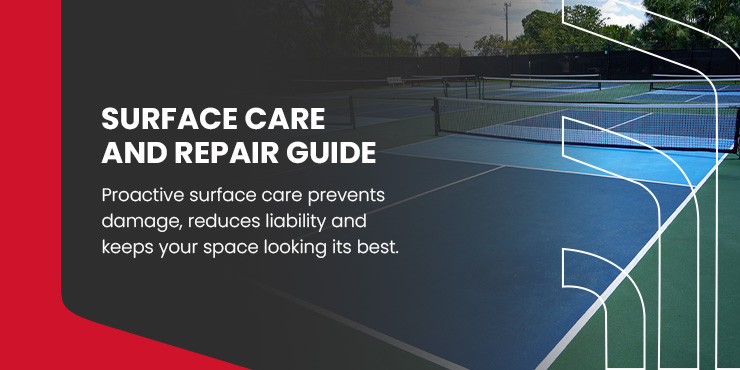
Surface Care and Repair Guide
Your pickleball courts are the foundation of your facility's safety, performance and appeal. Heavy foot traffic and exposure to the elements can take a toll, especially in outdoor settings. Proactive surface care prevents damage, reduces liability and keeps your space looking its best.
Warning Signs
Carefully examine the surface at least once a month for warning signs like these:
Hairline or wider cracks
Faded or worn court lines
Peeling, bubbling and fading
Bumps, low spots and uneven areas
Worn-down texture
Fast Fixes
Promptly addressing small issues will prevent costly future repairs.
Hairline cracks: Clean dirt out of the crack and fill it with a compatible product. Smooth with a putty knife and let it dry.
Minor surface chips: Use an appropriate patch mix or resurfacer. Lightly sand it and touch it up with a matching color coating.
Peeling paint lines: Gently scrape away loose edges and clean the area. Apply a line paint for the touch-up.
Small puddles: Use a squeegee or court roller to remove water immediately. Allow to dry and apply a specialized patching compound to fix the uneven surface.
Worn net straps: Tighten or, if necessary, replace the straps. Check for rust or slippage.
Minor surface stains: Use a mild detergent to gently scrub away stains. Rinse the court thoroughly afterward and allow it to dry.
Depending on your environment and the amount of traffic the court experiences, you may need to have it professionally resurfaced every few years.
Fencing
Pickleball fencing takes a beating from the weather, balls and player activities. Maintain durable fences by doing the following:
Inspect it every few weeks for loose ties and sagging mesh.
Clean metal to prevent rust.
Check that all posts remain firmly anchored in place.
Tighten bungee cords or zip ties.
Trim vegetation along the base to prevent trapped moisture.
Safety Netting
Don't overlook maintenance of pickleball netting as you work to extend your court's lifespan.
Check the tension daily to maintain the correct height.
Immediately replace worn nets.
Wash the netting periodically with a gentle soap and allow it to dry completely.
Lubricate hardware to prevent rust buildup.
Store unused netting in a temperature-controlled area.
Pickleball Court Maintenance Tips for Facility Managers
Here are additional maintenance tips to consider.
Do a daily walk-through: Perform a quick visual inspection before opening the court.
Keep a dedicated cart: Organize all your maintenance equipment in one dedicated place for easy access.
Log maintenance checks: Keep records of your inspections, cleaning, repairs and vendor visits in case you need to refer to them later.
Schedule quiet hours: Block off time before or after your standard business hours to complete deep cleaning and repairs without interrupting play.
Label maintenance zones: Clearly mark under-repair areas so players can easily see which areas to avoid.
Post court rules: Communicate safety requirements and maintenance protocols by putting large, easy-to-read signs in shared areas.
Invest in quality materials: Choosing durable, well-made materials and equipment can reduce replacement costs.

Build a Safer, Lower-Maintenance Facility With Grand Slam Safety
Capitalize on pickleball's popularity by creating a welcoming facility players will love to use. And when you need to replace your fencing, choose durable, built-to-last systems from Grand Slam Safety.
We've established ourselves as industry experts since 2008, offering a range of proprietary sports containment products and creating ideal environments for players and spectators. We also provide multisport complex design and consulting services for new and aspiring facility managers.
Contact us online to discover how our pickleball facility solutions can safeguard your investment and ensure athlete safety.


Commercial buildings require roofing systems that can handle larger structures and greater environmental demands. A professional roofing company has the skills and equipment needed to install and maintain commercial roofs efficiently. Proper planning, quality materials, and experienced workmanship ensure minimal disruption to daily business Windows Installation operations. Routine inspections and maintenance also extend the lifespan of commercial roofing systems while reducing unexpected repair costs and operational downtime.
El significado de los sueños se explica mediante interpretaciones sencillas y fáciles de seguir. La información está organizada para facilitar la búsqueda, ofreciendo una lectura cómoda que ayuda a comprender diferentes símbolos y situaciones relacionadas con los sueños.
One thing that came to my mind while reading this was how a good maintenance routine is a lot like checking What Day Is Today every morning. It only takes a minute, but that small daily habit keeps everything on track before little problems become big ones. I've seen sports facilities that looked perfect when they opened, yet within a couple of seasons they started showing cracks simply because nobody stayed consistent with the basics. This checklist feels practical because it focuses on regular care instead of waiting for expensive repairs, and that's usually the difference between a court that lasts for years and one that constantly needs fixing.
I liked how the article treated court maintenance as something that directly affects the players' experience, not just the facility's appearance. It actually reminded me of La Calculadora de Alicia in an unexpected way. Whether you're managing numbers or maintaining a pickleball court, the best results come from paying attention to small details before they become bigger problems. I've seen too many places wait until cracks or damaged nets become impossible to ignore, and by then the repair costs are much higher. A consistent maintenance routine may not seem exciting, but over the years it's always been the smartest investment.
C’est un article très complet sur la maintenance physique des infrastructures. De nos jours, la gestion des terrains passe aussi par des outils numériques, notamment des systèmes de réservation en ligne. Lors de la collecte des données personnelles des joueurs, la mise en œuvre d'une architecture de sécurité renforcée est essentielle. J'ai étudié récemment les protocoles de chiffrement SSL utilisés par des plateformes régionales complexes, comme celles déployées sur https://paris-sportifs.africa/cameroun/, qui sécurisent au maximum les points d'entrée des utilisateurs. Vos systèmes de gestion de club intègrent-ils ce type de protection ?